Romantic Age svelato: il trucco per capire Wordsworth e Keats (riassunto maturità)
Guida completa al Romanticismo inglese: dal contesto storico della Rivoluzione Francese alle Lyrical Ballads, dalle due generazioni di poeti ai trucchi per l'orale. Tutto quello che serve sapere su Wordsworth, Coleridge, Byron, Shelley e Keats.
Se pensi che il Romanticismo sia solo "poesia sulla natura con tante emozioni", stai perdendo metà dell'orale. Questo movimento, che irrompe tra il XVIII e XIX secolo, è una vera e propria rivoluzione culturale che cambia per sempre il modo di vedere il mondo, l'individuo e l'arte. Preparati, perché qui trovi l'appunto definitivo che ti fa collegare Storia, Filosofia e Letteratura senza sudare.
Beyond Nature: What Romanticism Really Means
Let's get one thing straight: Romanticism is not the opposite of "romantic" in the modern sense of cheesy love stories. It's a radical shift in consciousness. Emerging around 1780-1850, this movement rejects the cold rationalism of the Enlightenment (think Locke, think pure reason) and celebrates instead the power of imagination, emotion, and individual experience.
The Romantics believed that truth isn't found in dusty books of philosophy or scientific laboratories, but in the spontaneous overflow of powerful feelings (as Wordsworth will famously define poetry). They saw the poet not as a skilled craftsman arranging words, but as a prophet, a visionary, a genius capable of seeing deeper truths invisible to ordinary men.
The poet is a man speaking to men... a man pleased with his own passions and volitions, and who rejoices more than other men in the spirit of life that is in him. — William Wordsworth, Preface to Lyrical Ballads (1800)
This is the core shift: from reason to heart, from society to individual, from classical rules to organic creativity. But to understand why this happens, you need to look at the blood, smoke, and hope of the Historical Context.
Blood, Smoke, and Hope: The Historical Context (1789-1832)
Here's where students often get confused: they study the French Revolution in History class and Wordsworth in English class as if they were separate planets. Wrong. The Romantic Age is unimaginable without the French Revolution (1789) and the seismic shocks it sends across Europe.
The French Revolution: From Ecstasy to Terror
When the Bastille fell in 1789, young intellectuals across Europe saw it as the dawn of a new era. Wordsworth famously wrote: "Bliss was it in that dawn to be alive, / But to be young was very heaven!" The Revolution promised liberty, equality, fraternity—a break from centuries of tyranny.
But then came the Reign of Terror (1793-94), the guillotine, the Napoleonic Wars. This trajectory—from idealistic hope to violent disillusionment—becomes the psychological blueprint for the entire Romantic generation. The Romantics are haunted by this paradox: can you achieve freedom without destruction? This tension feeds the "dark" side of Romanticism (think Byron's heroes, think Shelley's Prometheus Unbound).
The Industrial Revolution: Darkness in the Green Fields
While France bleeds, England changes skin. The Industrial Revolution begins transforming the landscape. Steam engines, factories, urbanization—the "dark satanic mills" (Blake) start eating the English countryside. This creates a double movement in Romantic literature:
Escape into Nature: The Lake District becomes a sanctuary. Nature isn't just scenery; it's a moral and spiritual force, a healing alternative to the mechanical brutality of industrial cities.
Social Critique: Writers like Blake in his Songs of Innocence and Experience (1789-1794) expose the exploitation of child labor and the loss of innocence in industrial society.
The Napoleonic Wars (1803-1815)
The long war against Napoleon creates a climate of censorship, paranoia, and nationalism. The Peterloo Massacre (1819)—when cavalry charged a peaceful pro-democracy rally in Manchester—shows that England, despite defeating the "tyrant" Napoleon, isn't so democratic itself. This feeds the radical political edge of the Second Generation Romantics (Shelley, Byron).
The Manifesto: Lyrical Ballads (1798) and the Preface (1800)
If you remember one date, remember 1798. This year marks the unofficial birth of English Romanticism with the publication of Lyrical Ballads by William Wordsworth and Samuel Taylor Coleridge. It's a small book that explodes like a bomb in the literary establishment.
The 1798 edition opens with Coleridge's The Rime of the Ancient Mariner (supernatural, exotic, medieval) and closes with Wordsworth's Tintern Abbey (introspective, natural, philosophical). Together, they map the two poles of Romanticism.
But the real revolution comes with Wordsworth's Preface to the Second Edition (1800), effectively the manifesto of Romantic poetry. Here Wordsworth declares war on the artificial "poetic diction" of the 18th century (Alexander Pope's sophisticated couplets). He argues for:
Ordinary language: The language "really used by men" (and women), not aristocratic latinisms.
Common subjects: Humble people—farmers, children, beggars—are worthy of high poetry.
Emotion recollected in tranquility: Poetry isn't immediate emotional vomit; it's a crafted recreation of feeling that produces pleasure through reflection.
This is democratic art. It's saying: your grandmother's stories matter as much as Greek mythology. Revolutionary? Absolutely.
The Five Pillars of Romanticism
Figure 1: The Five Pillars connecting to the central concept of Imagination
When you're at the simulazione orale and the professor asks "What characterizes Romanticism?", don't panic. Use this pentagon structure:
1. Imagination vs. Reason
For the Enlightenment, imagination was dangerous, irrational. For Romantics, it's the supreme faculty. Coleridge distinguishes between fancy (mere mechanical association) and imagination (the living, creative power that dissolves and recreates reality). Through imagination, we grasp the infinite.
2. Nature as Living Spirit
Nature isn't dead matter (Newton's clockwork universe). It's a living, spiritual presence. Wordsworth speaks of "something far more deeply interfused" in the natural world—a divine presence accessible through direct experience. This is often pantheistic (God is in everything) rather than orthodox Christian.
3. The Individual and the Child
The Romantic hero is the outsider, the dreamer, the rebel (Byronic hero). But there's also celebration of childhood as a state of privileged spiritual vision. Blake's Songs of Innocence show children as closer to God and truth; Wordsworth's "Intimations of Immortality" argues we are born trailing clouds of glory that fade as we age into social conventions.
4. The Medieval and the Exotic
Neoclassicism looked to Ancient Greece and Rome. Romantics look to the Middle Ages (Gothic cathedrals, knights, ballads) and to the exotic (Orient, Arabia, remote islands). Coleridge's Kubla Khan and Keats's La Belle Dame sans Merci exploit this medievalism for mystery and emotional intensity.
5. Revolution and Rebellion
Whether political (Shelley's radicalism, Byron's support for Greek independence) or metaphysical (rebellion against mortal limits), Romanticism has a revolutionary DNA. Even the conservative Wordsworth starts radical. The poet is often a Luciferian figure, challenging gods and social norms.
The Two Generations: Fathers and Prodigal Sons
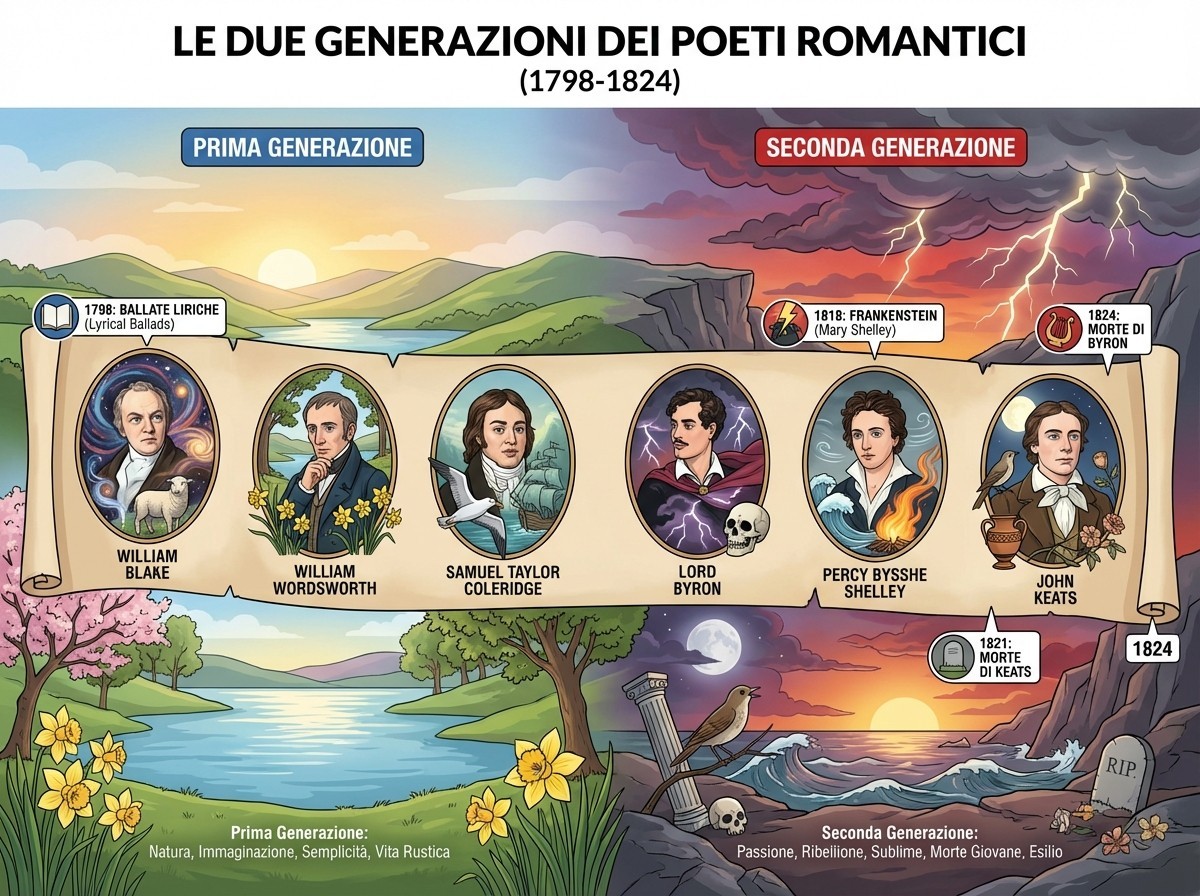
Figure 2: Timeline of the First and Second Generation Romantic Poets (1798-1824)
English Romanticism isn't a monolith. It splits into two distinct waves, and understanding the difference is crucial for your oral exam.
First Generation (1780s-1800s): The Philosophers of Nature
William Blake (1757-1827), William Wordsworth (1770-1850), and S.T. Coleridge (1772-1834) are shaped by the French Revolution's promise. They seek:
Blake: Mystical, prophetic, a universe of personal mythology (Los, Urizen, Innocence vs Experience). He engraves his own books; he's outside any academy.
Wordsworth: The poet of memory and nature. His masterpiece The Prelude (1805, pub. 1850) is the first great modern autobiography in verse—"the growth of a poet's mind."
Coleridge: The theorist and dreamer. Biographia Literaria (1817) defines imagination. His poems (Kubla Khan, Christabel) explore the supernatural and the unconscious.
Second Generation (1810s-1820s): The Byronic Rebels
Lord Byron (1788-1824), Percy Bysshe Shelley (1792-1822), and John Keats (1795-1821) inherit a disillusioned world. Napoleon is defeated; the Restoration has returned tyrants to thrones. They are more radical, more self-destructive, more aesthetically refined.
Byron: Creates the Byronic Hero—beautiful, damned, rebellious, aristocratic, haunted by a mysterious past (Childe Harold, Manfred). He dies fighting for Greek independence. Celebrity culture starts with him.
Shelley: The most radical politically. Ode to the West Wind, Prometheus Unbound. Atheist, vegetarian, expelled from Oxford for writing "The Necessity of Atheism."
Keats: The pure aesthete. "Beauty is truth, truth beauty." He perfects the ode form. Ode to a Nightingale, Ode on a Grecian Urn. He dies of tuberculosis at 25, believing he failed.
Key distinction: First Generation seeks reconciliation with Nature; Second Generation often seeks escape from a corrupted world through art or death.
Memory Tricks: How to Nail the Oral
Here's the cheat sheet for when anxiety hits during the Quiz Maturità AI or the real exam:
The "IRONY" acronym for Romantic features:
Imagination over Reason
Revolution (French + Industrial)
Ordinary language (Wordsworth's Preface)
Nature as spiritual guide
Youth/Childhood as sacred
The "WICK" poets (Second Gen, chronologically):
Wordsworth? No, he's First Gen. Think: Byron (but B doesn't fit... wait).
Better: BSK (Byron, Shelley, Keats) — sounds like "bullshit king" (sorry, but you'll remember it). Or The "Young Romantics" — all died young (Byron 36, Shelley 29, Keats 25).
Dates anchor:
1789: French Rev + Blake's Songs of Innocence
1798: Lyrical Ballads (Big Bang of Romanticism)
1818: Frankenstein (Mary Shelley — yes, women write too!)
1821: Keats dies
1850: Wordsworth dies (end of an era)
Interdisciplinary Links for the Oral Exam
This is where you score extra points. Don't just talk about poetry; connect the dots:
Subject
Connection
Example
History
French Revolution → Disillusionment → Conservative backlash
Wordsworth's shift from radical to conservative
Philosophy
Rousseau's "Noble Savage" vs. social corruption
Blake's "Songs of Innocence"
Art History
Caspar David Friedrich (German Romantic painter)
The "Wanderer above the Sea of Fog" = Romantic sublime
Italian Literature
Foscolo's Sepolcri (1807) and Leopardi
Shared themes: memory, ruins, infinite
Music
Beethoven's 3rd Symphony (Eroica)
Dedicated to Napoleon, then title revoked
Pro tip: Mention Mary Shelley's Frankenstein (1818) as the Romantic novel par excellence—it's the dark side of Romantic pursuit of knowledge (scientific hubris) and the alienated creature is the ultimate Romantic outcast.
The Bottom Line: What You Must Remember
The Romantic Age (c. 1780-1850) is a reaction against Enlightenment rationalism and a response to the French Revolution and Industrialization.
Lyrical Ballads (1798) + Wordsworth's Preface (1800) = the manifesto.
Key concepts: Imagination, Nature, Individualism, Emotion, The Sublime.
First Generation (Wordsworth, Coleridge, Blake): Nature as healing, philosophical.
Second Generation (Byron, Shelley, Keats): Nature as escape, aesthetic, politically radical.
The "Negative Capability" (Keats): the ability to exist in uncertainties, mysteries, doubts without reaching after fact and reason.
Remember: the Romantics invented modern consciousness. Before them, you were a role in society; after them, you are a unique, suffering, glorious individual. That's why they still matter.
FAQ: Domande frequenti all'orale
Qual è la differenza principale tra First e Second Generation?
The First Generation (Wordsworth, Coleridge, Blake) witnessed the French Revolution and initially supported its ideals, seeking in Nature a spiritual and democratic renewal. The Second Generation (Byron, Shelley, Keats) grew up during the Napoleonic Wars and the Restoration, resulting in a more cynical, rebellious, and aesthetically focused attitude. While Wordsworth finds "tranquil restoration" in nature, Keats seeks "easeful Death" and Byron creates the alienated, aristocratic rebel.
Cosa significa "Negative Capability" di Keats?
Coined by Keats in a letter (1817), Negative Capability describes the artist's capacity to remain in "uncertainties, mysteries, doubts, without any irritable reaching after fact and reason." Unlike the Enlightenment man who seeks to categorize and control, the Romantic poet accepts ambiguity and multiple truths. This allows for the creation of complex, suggestive art like the Ode on a Grecian Urn.
Perché la natura è così importante nel Romanticismo?
For Romantics, Nature is not just scenery but a living, moral, and spiritual force. It represents:
An alternative to the mechanical, industrial city (social critique)
A manifestation of the divine (pantheism)
A mirror for the poet's emotions (correspondence between inner and outer world)
A teacher of truth (Wordsworth's "nurse, guide, guardian" in Tintern Abbey)
Come collego il Romanticismo alla Rivoluzione Industriale?
Il Romanticismo nasce come reazione critica all'Industrial Revolution che trasforma l'Inghilterra. I poeti vedono le "dark satanic mills" (Blake) distruggere il paesaggio e sfruttare donne e bambini. La fuga verso il Lake District (Wordsworth) o verso il Medioevo (Keats, Coleridge) è una critica implicita al materialismo e alla razionalità strumentale dell'epoca industriale.
Chi è il Byronic Hero?
The Byronic Hero is an archetype created by Lord Byron in works like Childe Harold's Pilgrimage and Manfred. He is:
Noble, aristocratic, but brooding and mysterious
Haunted by a dark, unnamed sin from the past
Rebellious against all forms of tyranny and social convention
Passionate yet incapable of normal human happiness
An outsider, often exiled or wandering
This figure influences later literature from Heathcliff (Wuthering Heights) to modern anti-heroes.