Dickens: perché odiava la rivoluzione industriale? Il segreto che ti fa prendere 10 all'orale
Guida completa a Charles Dickens and Social Criticism per la maturità: dal contesto storico della Rivoluzione Industriale all'analisi di Oliver Twist e Hard Times, con collegamenti interdisciplinari e trucchi mnemonici per l'orale.
The Voice of the Voiceless: Why Dickens Still Matters
Imagine walking through the foggy streets of London in 1840. You hear the clatter of factory machinery before you see the buildings themselves. Children as young as six work sixteen-hour shifts. The air smells of coal and despair. This is the world Charles Dickens (1812-1870) forced his Victorian readers to confront—not through political pamphlets, but through stories that made them feel the injustice.
Here is the crucial point many students miss: Dickens was not merely a novelist; he was a social reformer who used fiction as a weapon. While politicians debated the Repeal of the Corn Laws (1846) and philosophers theorized about Utilitarianism, Dickens showed the human cost of the Industrial Revolution. He transformed the "social problem" novel into an art form, influencing everything from labour laws to public health reform.
Why does this matter for your oral exam? Because Dickens represents the perfect intersection of literature and history. When you discuss the Victorian Age, you cannot separate the steam engine from the starving child. Dickens understood this connection better than anyone.
The Hungry Forties: England Under the Smoke
The brutal reality of industrial Manchester: smoke, overcrowding, and exploitation
To understand Dickens's anger, you must first understand the Industrial Revolution. Between 1830 and 1860, Britain transformed from an agricultural society into "the workshop of the world." But this progress came at a devastating human price.
The Dark Side of Progress
The material conditions were horrific. In cities like Manchester—which Dickens visited and despised—workers lived in "little Ireland," districts with no sewage, no clean water, and refuse thrown into the streets. The statistics are shocking: while an agricultural labourer had a life expectancy of 38 years, a Manchester factory worker died on average at 17. Over half of working-class children died before age five.
The factories themselves were "jungles where the law was the survival of the fittest." Women and children were exploited in textile mills for wages that could not sustain life. This was the era of the "Hungry Forties," when the Corn Laws kept bread prices artificially high to protect landowners, starving the industrial workforce.
The Political Context
The Reform Bill of 1832 had extended voting rights to the middle classes, but the working classes remained disenfranchised until the Second Reform Bill (1867). The Chartist movement demanded political rights, while the memory of the Peterloo Massacre (1819)—where cavalry charged unarmed protesters—still haunted the working class.
Against this backdrop, writers like Elizabeth Gaskell (author of Mary Barton) and Benjamin Disraeli wrote "social problem" novels. But Dickens transcended the genre. He didn't just describe poverty; he made the bourgeois reader empathize with the poor.
Dickens's social criticism rests on four interconnected pillars. Master these, and you master Dickens.
1. The Exploitation of Childhood
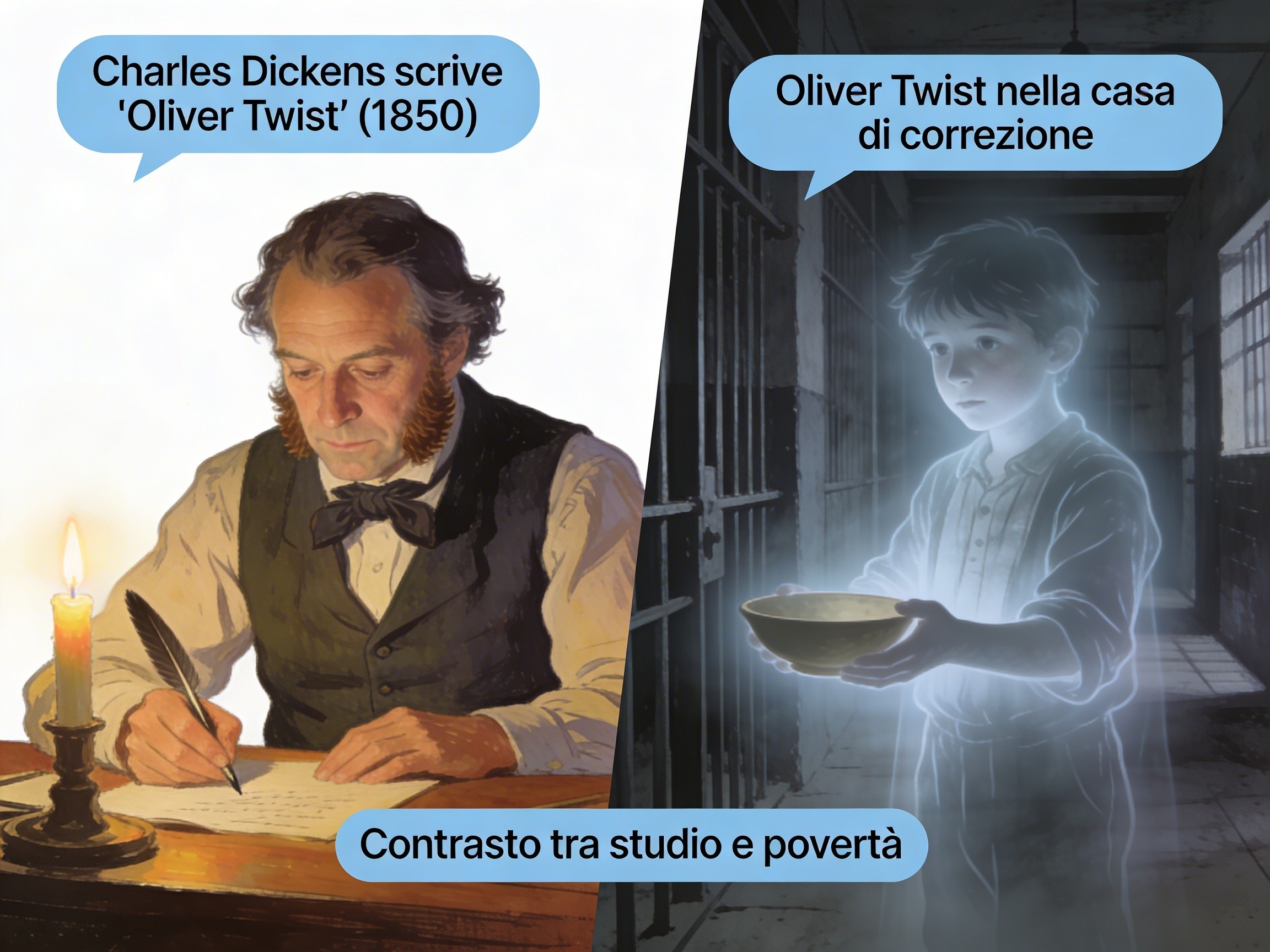
Dickens's own trauma shaped his art. At age twelve, his father was imprisoned for debt, and young Charles worked at Warren's Blacking Warehouse, labeling pots for ten hours a day. This experience of child labour burned into his consciousness.
In Oliver Twist (1838), the workhouse system becomes a symbol of bureaucratic cruelty. When Oliver dares ask for more gruel—"Please, sir, I want some more"—he challenges not just the beadle Bumble, but an entire system that treated the poor as statistical problems rather than human beings.
2. The Tyranny of Utilitarianism
Here is where philosophy meets literature. Dickens fiercely attacked the Utilitarianism of Jeremy Bentham and John Stuart Mill, which measured human worth through statistics and "the greatest good for the greatest number."
In Hard Times (1854), set in the fictional industrial town of Coketown, the character Thomas Gradgrind embodies this philosophy. His school teaches "facts, facts, facts," crushing imagination and emotion. Dickens shows that reducing humans to economic units creates not prosperity, but spiritual death.
"Now, what I want is, Facts. Teach these boys and girls nothing but Facts. Facts alone are wanted in life." —Hard Times, Book I, Chapter 1
3. The Dehumanization of Industrial Labour
The industrial town in Dickens is never just background; it is a character that oppresses. In David Copperfield (1850), the debtor's prison and the blacking warehouse appear as institutions that grind down the human spirit. The contrast between the idyllic countryside of Dickens's childhood and the "smoky centres of manufacturing industry" reflects a national trauma.
4. The Hypocrisy of Middle-Class Respectability
Dickens reserved his sharpest satire for the "philanthropists" and bureaucrats who administered poverty without understanding it. The Board of Guardians in Oliver Twist, the Podsnaps in Our Mutual Friend—these characters profess Christian charity while practising social cruelty.
From Oliver Twist to Hard Times: A Literary Battlefield
Dickens at work: giving voice to the forgotten victims of industrialization
Let's examine the specific works you must know for your exam. These are not just stories; they are indictments.
Oliver Twist (1838): The Parish Boy's Progress
The novel attacks the New Poor Law of 1834, which established workhouses as a deterrent to poverty. Dickens exposes the "parochial system"—where parishes competed to spend less on the poor—as institutionalized sadism.
Key characters: Fagin represents the criminal underworld created by poverty; Nancy shows the impossibility of redemption in a society that brands fallen women; Mr. Brownlow offers the possibility of benevolent capitalism.
Hard Times (1854): Utilitarianism on Trial
Set in the soot-covered Coketown (based on Preston and Manchester), this novel targets both industrial capitalism and philosophical utilitarianism. Stephen Blackpool, the honest worker trapped between striking workers and intransigent mill owners, represents the moral centre. His fall down the abandoned mine shaft symbolizes how industrial society discards its workers once they are broken.
Crucial insight: Notice how Dickens contrasts the "Hands" (workers reduced to body parts) with the fully human characters who retain imagination.
David Copperfield (1850): The Bildungsroman as Social Document
This semi-autobiographical novel traces how poverty deforms childhood. The Murdstone siblings represent domestic tyranny, while Uriah Heep embodies the social climbing made necessary by class insecurity. The novel asks: can moral integrity survive economic desperation?
Laughing Through Tears: The Art of Victorian Satire
Dickens's genius lay in his method. He knew that lecturing readers would fail; instead, he made them laugh, then caught them off-guard with pathos.
Caricature and Hyperbole
Characters like Bumble the beadle or Gradgrind are caricatures—exaggerated to the point of absurdity. This technique, derived from the theatre, makes abstract systems (bureaucracy, utilitarianism) viscerally ridiculous.
The Omniscient Narrator as Moral Compass
Dickens's narrator is not neutral. He guides your emotional response, directing anger at systems and compassion toward victims. This "emotional didacticism" was revolutionary—it transformed the novel from entertainment into moral education.
Symbolism and Setting
The fog in Bleak House, the dust heaps in Our Mutual Friend, the machinery in Hard Times—these are not mere atmosphere. They symbolize how industrial modernity obscures, corrupts, and crushes human life.
Beyond the Page: Dickens's Real-World Impact
Dickens did not just write about reform; he caused it. His detailed descriptions of the Yorkshire boarding schools (in Nicholas Nickleby) led to investigations and closures. His portrayal of the Chancery Court (in Bleak House) contributed to judicial reform.
More importantly, he changed how the middle class saw the poor. Before Dickens, poverty was often attributed to moral failing. After Dickens, it was seen as a social condition requiring structural solutions.
Interdisciplinary Connections for Your Oral Exam
To impress your examiners, connect Dickens across subjects:
History: Link Hard Times to the Repeal of the Corn Laws (1846) and the rise of Trade Unionism.
Philosophy: Contrast Dickens's humanism with Bentham's Utilitarianism and Thomas Carlyle's critique of the "cash nexus."
Italian Literature: Compare Dickens's social realism with Verga's Verismo or Zola's Naturalism—how does British social criticism differ from Continental models?
Art: Connect Dickens's descriptions of industrial towns with the paintings of L.S. Lowry or the photography of social reformers.
Prepare for your exam with our Quiz Maturità AI to test your knowledge of these connections.
The Essential Summary: Dickens in 5 Points
Element
Description
Key Example
Historical Context
Industrial Revolution, Poor Laws, Utilitarianism
Manchester, 1840s
Main Targets
Workhouses, child labour, "facts-based" education
Bumble, Gradgrind
Key Works
Social novels of the 1840s-50s
Oliver Twist, Hard Times
Narrative Technique
Caricature, pathos, omniscient moral narrator
Fog symbolism, irony
Legacy
Social reform, empathy for the poor
Education Acts, labour laws
FAQ: Domande frequenti all'orale
Quali sono le opere più importanti di Dickens per il social criticism?
The essential texts are Oliver Twist (1838), which attacks the workhouse system; Hard Times (1854), a critique of utilitarianism and industrial capitalism; and David Copperfield (1850), which examines how poverty affects childhood development. For advanced discussion, include Bleak House (1853) for its critique of the legal system.
Che cos'è l'utilitarismo e perché Dickens lo critica in Hard Times?
Utilitarianism, theorized by Bentham and Mill, advocated measuring actions by their utility—"the greatest good for the greatest number." Dickens feared this reduced human beings to statistics. In Hard Times, Gradgrind's school teaches "facts alone," producing emotionally stunted individuals like Louisa and Bitzer. Dickens argues that without imagination and compassion, society becomes mechanically cruel.
Come rappresenta Dickens la Rivoluzione Industriale?
Dickens portrays industrialization not as progress but as dehumanization. In Hard Times, Coketown is described as a "town of red brick, or of brick that would have been red if the smoke and ashes had allowed it." Workers become "Hands," mere appendages to machines. The industrial landscape is consistently associated with fog, soot, and moral darkness, contrasting sharply with the pastoral England of his childhood.
Qual è il legame tra la biografia di Dickens e il suo impegno sociale?
Dickens's father was imprisoned for debt when Charles was twelve, forcing the boy to work at Warren's Blacking Warehouse. This trauma of child labour and familial shame instilled in him a lifelong identification with the vulnerable. His fiction repeatedly returns to themes of imprisoned fathers, debtor's prisons, and the brutalization of childhood—transforming personal pain into social protest.
Come si collega Dickens agli altri autori del suo tempo?
Dickens was part of the "social problem novel" movement alongside Elizabeth Gaskell (Mary Barton, 1848) and Benjamin Disraeli (Sybil, 1845). However, while Gaskell offered sympathetic portrayals of industrial conflict and Disraeli promoted "Tory philanthropy," Dickens focused on the moral transformation of the individual reader. He was less interested in political solutions than in awakening the conscience of the middle class.